Mechatronics Lab Professor — SJSU
RC Filter
Analog filter design lab covering low-pass and high-pass RC circuits, Bode plot analysis, cutoff frequency selection, and sensor signal conditioning.
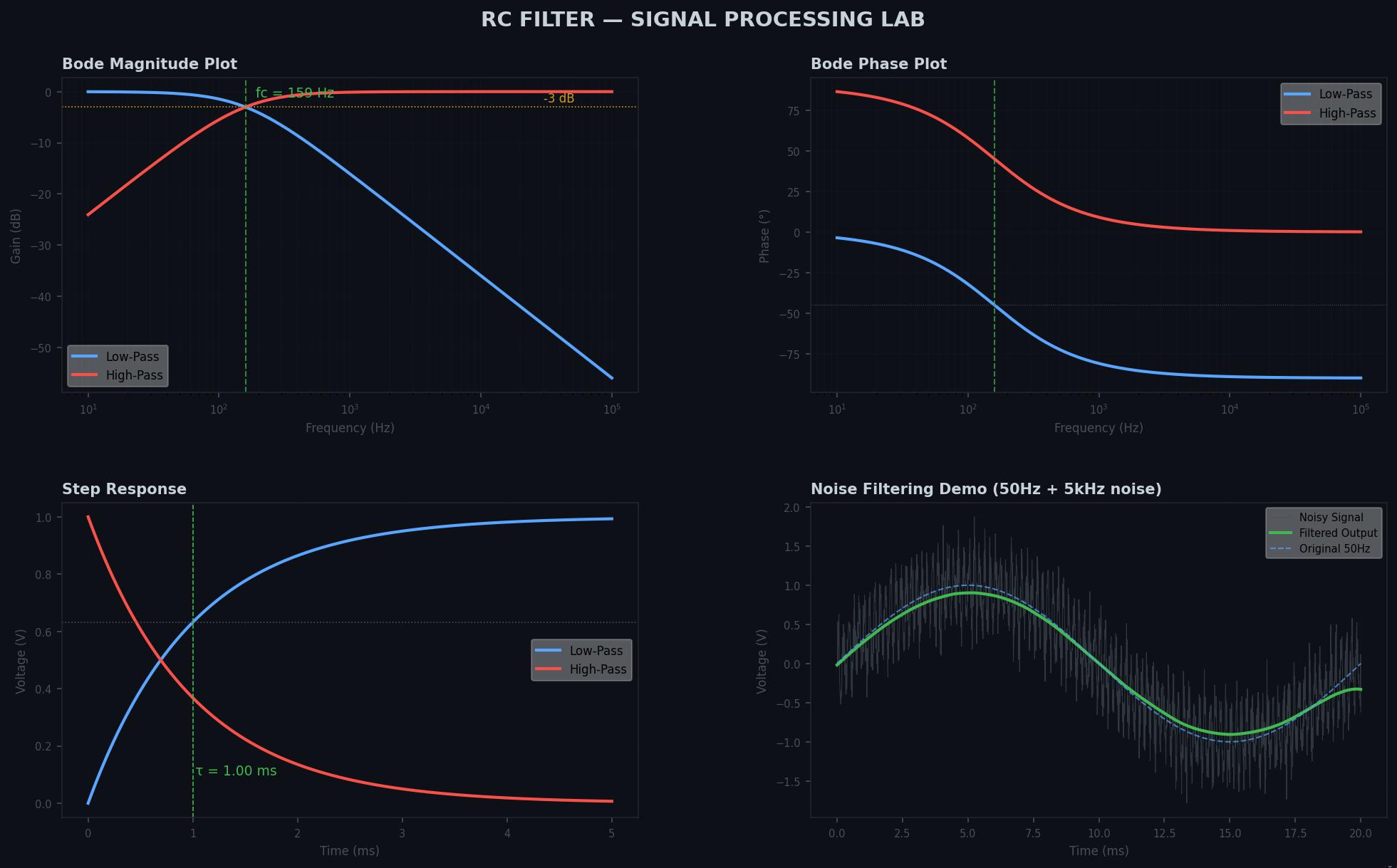
Lab 3: RC Filter introduced students to the fundamentals of analog signal conditioning — a critical skill for any engineer working with real-world sensors. Noisy or bandwidth-limited signals are the norm in mechatronics, and this lab gave students the tools to design, build, and characterize passive filters for noise reduction and signal smoothing.
Students constructed first-order low-pass and high-pass RC filters on a breadboard, calculated cutoff frequencies from component values (f_c = 1 / 2πRC), and verified their designs by sweeping a function generator across a range of frequencies while measuring output amplitude and phase shift on an oscilloscope. They plotted Bode magnitude and phase diagrams by hand and compared them to theoretical predictions.
The lab extended into practical applications: students filtered a noisy analog sensor signal (e.g., a potentiometer with injected high-frequency noise) and observed the cleaned output on the Arduino's serial plotter. They explored the trade-off between noise rejection and response time — choosing a lower cutoff frequency removes more noise but introduces lag. The exercise concluded with a discussion of when passive RC filters suffice versus when active filters or digital filtering (moving average, Kalman) are needed.